


I don’t think people fully understand how big this moment is.
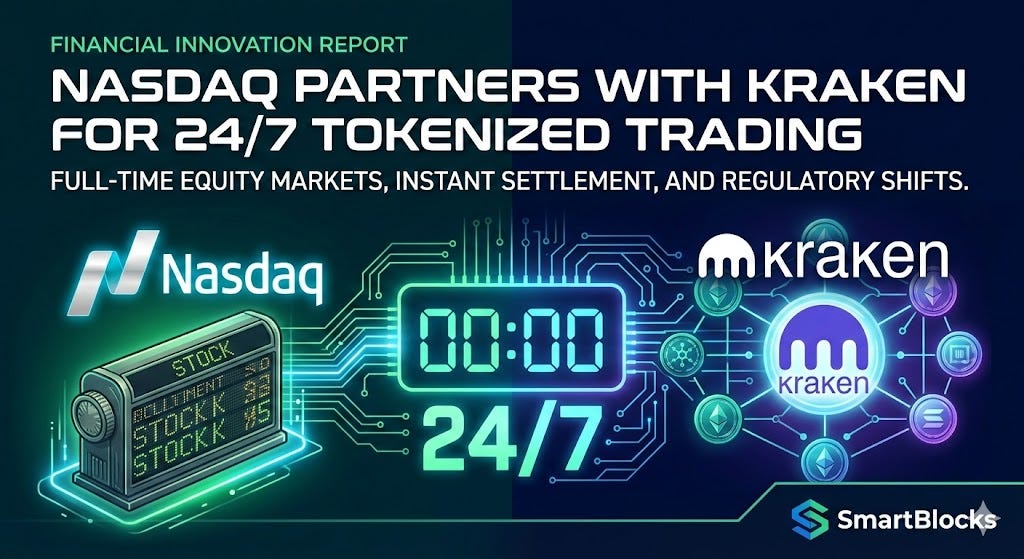
The Nasdaq just partnered with Kraken to build infrastructure for 24/7 trading of tokenized stocks and ETFs.
Let that sink in for a second.
Not extended hours trading.
Not premarket.
Not some experimental sandbox.
Full 24 hours a day, 365 days a year equity trading.
And the platform enabling it is not Schwab, TD Ameritrade, or Fidelity.
It’s Kraken.
Why This Is Such a Big Deal
The traditional stock market runs on infrastructure that was designed decades ago.
Markets open.
Markets close.
Settlement takes days.
Transfer agents update records slowly.
And global investors have to work around U.S. trading hours.
Tokenization changes that completely.
Instead of shares moving through legacy clearinghouses and brokers, the ownership record can live on a blockchain. That means transactions can settle almost instantly and the market can operate continuously.
What Nasdaq and Kraken are building is effectively a parallel financial rail for equities.
One that operates globally.
The Regulatory Door Just Opened
The timing here is not accidental.
Last week something very important happened that most people missed.
The Federal Reserve, FDIC, and OCC confirmed that tokenized securities receive the same capital treatment as traditional securities.
Translation in plain English.
To regulators and banks, tokenized stocks are still stocks.
That single decision removes a massive barrier that had been holding institutional adoption back.
Now combine that with another development.
Kraken recently gained access to Federal Reserve payment rails.
That puts a crypto-native company inside the same settlement plumbing used by major banks.
What This Means for Global Markets
Think about what happens when you combine these pieces.
A major U.S. exchange.
A global crypto trading platform.
Blockchain settlement.
And regulatory alignment.
Suddenly equities can trade like crypto.
Anytime. Anywhere.
Investors in Asia no longer need to wait for U.S. markets to open.
Capital can move instantly across borders.
Dividends and proxy voting can be automated through smart contracts.
Nasdaq even confirmed that part of this initiative includes automating corporate governance functions like dividend distribution and proxy voting through blockchain infrastructure.
That alone could eliminate entire layers of administrative friction in the public markets.
Why This Could Trigger a Massive Capital Rotation
Once markets move to 24/7 tokenized rails, capital becomes dramatically more liquid.
And liquid capital moves faster.
When investors can buy fractional equities, move funds instantly, and trade around the clock, markets stop behaving like traditional exchanges and start behaving more like the internet.
The result is simple.
Liquidity explodes.
And when liquidity explodes, entirely new financial products emerge.
We saw this happen with crypto.
Now we are about to see it happen with equities and real-world assets.
The Calm Before the Storm
Right now we are still early.
Most investors are still operating in the legacy system.
Broker accounts.
Market hours.
Two day settlement cycles.
But the infrastructure shift has already started.
Tokenization is quietly building the rails for a completely new financial system.
And when it reaches scale, trillions of dollars will eventually move onto these rails.
Where SmartBlocks Fits
While large exchanges focus on tokenizing public equities, a much bigger opportunity exists in tokenizing real-world assets that have never been liquid before.
That includes commercial real estate, private equity, infrastructure projects, and income producing assets that traditionally required millions of dollars to access.
At SmartBlocks, we are building infrastructure that allows these assets to be structured, tokenized, and distributed globally while staying compliant with securities regulations.
The same forces that are about to transform public markets are about to transform private markets as well.
And private markets are significantly larger.
The shift has already started.
Most people just have not realized it yet.