


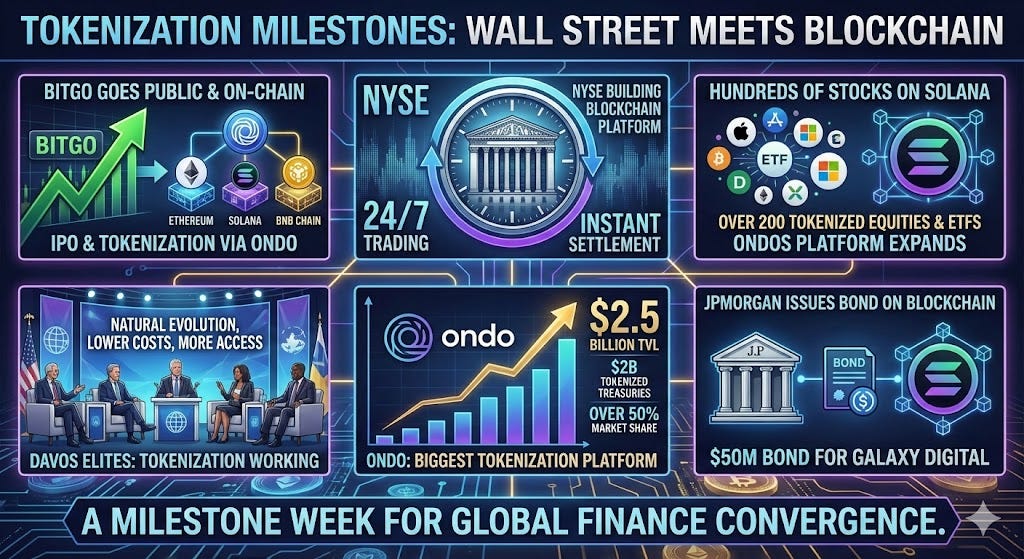
This week saw a flurry of breakthroughs in asset tokenization. From the New York Stock Exchange prepping 24/7 trading of on-chain stocks to hundreds of equities launching on Solana, even a crypto company’s stock got tokenized hours after its IPO. The line between traditional finance and on-chain markets is blurring fast.
BitGo goes public – and instantly goes on-chain
What is the story? Crypto custody firm BitGo raised $212.8 million in its NYSE IPO, marking one of the first digital asset companies to debut on U.S. markets this year. In a groundbreaking twist, tokenized BitGo shares launched on Ethereum, Solana, and BNB Chain within hours of the IPO via Ondo Finance. In other words, the same day BitGo stock started trading on Wall Street, it also became available to trade 24/7 on public blockchains.
Why does it matter? It’s a big deal when a crypto firm not only goes public but immediately bridges that stock to the blockchain. This move opens the door for global investors to trade a freshly IPO’d stock around the clock, beyond the limits of traditional market hours. It showcases how tokenization can extend the reach of equity markets and blur the line between “Wall Street” and “on-chain” – potentially setting a precedent for future IPOs to follow.
Hundreds of stocks hit the Solana blockchain
What is the story? Ondo Finance rolled out over 200 tokenized U.S. stocks and ETFs on Solana this week. Solana’s 3.2 million users can now buy and sell on-chain tokens that represent real-world equities – from tech giants to commodity and sector ETFs – through Ondo’s regulated platform. This expansion comes after Ondo’s earlier launches on Ethereum and BNB Chain, making it the largest catalog of tokenized equities on Solana to date.
Why does it matter? This dramatically broadens on-chain market access. Crypto traders on a fast, low-fee chain can now invest in mainstream stocks without leaving the crypto ecosystem, and do so 24/7. It’s a vote of confidence in Solana’s capability for high-performance finance and shows that tokenization isn’t limited to Ethereum – it’s becoming multi-chain. By bringing Wall Street assets onto Solana, this initiative bridges traditional and DeFi markets, potentially attracting more users to both sides.
NYSE builds for 24/7 tokenized stock trading
What is the story? The New York Stock Exchange’s parent company (ICE) is developing a blockchain-based platform to trade tokenized stocks and ETFs around the clock. This new digital exchange will enable 24/7 operations with instant on-chain settlement and even use stablecoins for funding trades. Essentially, the NYSE is preparing to shatter the old 9:30am–4pm trading window and allow investors to trade U.S. equities anytime, with transactions settling in seconds on a blockchain.
Why does it matter? When the world’s largest stock exchange is gearing up for always-on trading via tokenization, you know the paradigm is shifting. This signals that even the most established players see value in crypto technology to eliminate market frictions. Investors could eventually trade stocks at midnight or on weekends, which upends long-held market hours traditions. It also shows traditional finance embracing blockchain to solve pain points like slow settlement times and limited accessibility – a strong validation for the broader tokenization movement.
Davos elites: “Tokenization is finally working”
What is the story? At the World Economic Forum in Davos, global finance leaders struck an optimistic tone about tokenized assets moving from experiment to reality. Euroclear CEO Valérie Urbain framed tokenization not as a radical disruption but as a “natural evolution” of markets that can reach more investors while lowering costs and speeding up issuance. Panelists noted that as blockchain costs fall and cross-border frictions ease, tokenization and stablecoins are becoming core financial infrastructure, not just buzzwords.
Why does it matter? It’s significant when the traditional finance elite at Davos publicly back tokenization as the future of finance. That consensus means more big institutions are likely to invest in and adopt tokenized systems. The fact that leaders are talking about expanding investor access and cutting costs through blockchain suggests tokenization is shedding its “hype” status and proving its practical value. In short, when Davos power brokers agree something’s working, it adds serious credibility – expect to see accelerated efforts to integrate tokenized assets in mainstream markets.
Ondo becomes the biggest tokenization platform
What is the story? Tokenization startup Ondo Finance announced its platform has surpassed $2.5 billion in total value locked across its on-chain products. That makes Ondo the largest provider of tokenized U.S. Treasuries and stocks. Roughly $2 billion of that is in tokenized Treasury funds, and over $500 million in tokenized equities – giving Ondo more than 50% of the market share in on-chain stocks. In just a few months since launching its tokenized stock market in late 2025, Ondo raced past more established players to claim the top spot.
Why does it matter? Crossing the $2.5B milestone shows surging demand for on-chain versions of traditional assets. Big money (including institutions and asset managers) is clearly getting comfortable using crypto platforms to gain exposure to things like U.S. Treasuries – traditionally the safest asset class – but in a more accessible, 24/7 format. Ondo’s growth is a proof-point that tokenized real-world assets have product-market fit. It also highlights an emerging trend: new crypto-native platforms can compete with, and even outperform, traditional incumbents by offering more efficient access to financial products. In plain English, investors are voting with their dollars for tokenization as a viable alternative to legacy systems.
JPMorgan issues a real bond on blockchain
What is the story? In a notable first for a major bank, J.P. Morgan arranged a $50 million short-term bond for Galaxy Digital – and issued it on the public Solana blockchain. The deal was not a sandbox experiment; it used Circle’s USDC stablecoin for both issuance and redemption payments, with the entire bond lifecycle managed on-chain. This is one of the earliest instances of a Wall Street bank using a public crypto network to handle a traditional debt offering end-to-end.
Why does it matter? If the biggest bank in the U.S. is doing live bond deals on a blockchain, that’s a strong sign tokenization has entered the financial mainstream. It demonstrates real efficiency gains – like near-instant settlement and around-the-clock operation – that even conservative institutions can’t ignore. This could pave the way for more bonds and securities to follow suit. The fact that J.P. Morgan used Solana, a public chain (not just a private ledger), lends credibility to public blockchain tech in serious finance. In short, a heavyweight player proved that blockchain can handle big-league finance, potentially encouraging others to explore similar issuances and further erasing the divide between crypto and traditional capital markets.
woooow
One note is that $BTGO was just "tokenized" in a wrapper form - not native. When you get real native issuance alongside IPOs that's the real game-changer imo. I'm looking for tokenized shares THAT carry the same CUSIP, dividends, voting rights, and governance as traditional ones. The EXACT same assets. Not wrapped securities like you buy on Ondo, which rely on custodians or centralized infrastructure to hold the underlying asset.
I think Ondo's model is just a bridge to native which is done by firms like Securitize. Big institutional money won't come on-chain for wrappers... which is why the NYSE is developing a native model imo.